
The Boy Who Put His Hand Up
All names in this article are pseudonyms.
Mohammed
While reading existing research on relationships and sex education (RSE) in schools, I came across a frightening example of classroom practice. It was described by Jo Sell and Michael Reiss in a 2022 paper published in the journal Sex Education.
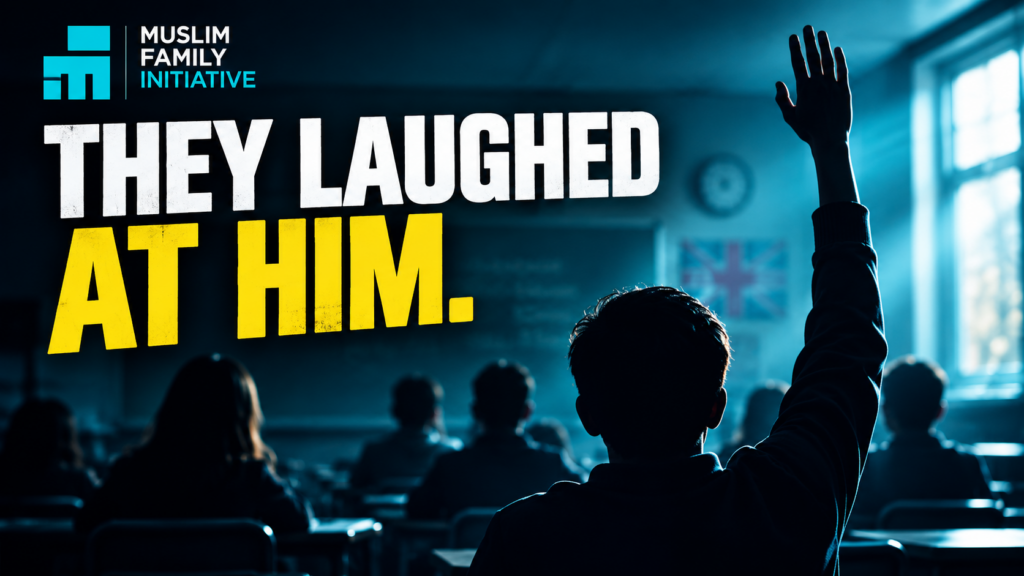
Mohammed was in a Year 10 classroom, with other fourteen and fifteen year olds and an external facilitator. The boys were told that they should always carry a condom with them, so that when they decided to have sex, they could have safer sex.
Mohammed put up his hand and said he did not want to do that. He was asked why. He said he did not intend to have sex until he was married, so he did not need to carry one.
The facilitator said, “Really?” and laughed at him. And then the rest of the class joined in.
What the laugh taught
Think about what Mohammed was being told. His view was not only dismissed. It was treated as so strange that it deserved ridicule, first from the facilitator and then from the whole class.
Imagine how he felt: alone, isolated, embarrassed, humiliated. And a laugh like that teaches every child in the room what happens to the one who speaks up.
He could have stayed silent. Many adults in his position would have been cowed into silence. Instead, he put his hand up, said what he believed and gave his reason. That speaks volumes about him.
One set of values as the default
Notice the sentence that started it. The boys were told to carry a condom “so that when they decided to have sex” they could have safer sex.
That sentence assumes that every boy in the room would. It is something we hear quite often: teachers and facilitators presenting personal positions, rooted in a secular-liberal worldview, as universal values. Sometimes there may be an agenda behind this. Often it is simply an unexamined assumption, that the views many people hold about moral decisions are the default for everyone, with no room for views outside them.
The point here is not the information. It is what happened to the child who held a different view.
Mohammed was brave, but he should not have had to be
Mohammed put his hand up. Not every child will. Many will stay silent, and some will not even know that they are allowed to disagree.
If we rely on the bravest child in the room to protect himself, we place a huge amount of responsibility on a child. That responsibility belongs to us, as parents. Our children should not have to be brave because we did not speak first.
A question that was not welcome
Here is another case. A child I will call Idris is eleven. After a week of LGBTQ-focused activities at school, run by an external provider, he submitted an anonymous question. The children had been told it was a safe space, and that they could ask anything without judgement.
His question was: why do we have to learn about LGBTQ when it goes against our religion?
After the half-term break, a member of staff came into the classroom and demanded that the child who had written “that bigoted question” identify himself. Idris, of course, did not. So the whole class was threatened with detention. Under that pressure, other children named him.
He was taken to another classroom and questioned. At no point was he told what he had done wrong. He was told, “you know what you did wrong”, and his confused look only made the adults angrier. He was threatened with serious punishment for “homophobia”.
When his mother called me, she told me he was in tears. The classmates who had named him kept asking what was going to happen to him, which made him more anxious.
The school asked for questions, and then treated a child as though he had done something wrong for asking one.
MFI helped his mother write a letter of complaint about how he had been treated. That same day, the school’s leadership called her in and apologised. Before agreeing to drop her complaint, she asked for three things: that the teacher apologise to Idris in front of the whole class, that staff undergo retraining, and that policies change so that no other child would go through the same thing. The school agreed to all three.
Do not wait for the problem
Every time MFI has advocated on behalf of a parent, the school has apologised. Parents’ voices work.
But it is important that we do not wait until something goes wrong. In both of these cases, the harm was done before an adult spoke. If we raise our questions with the school first, our children do not have to be the ones who stand up.
Our toolkit, Navigating Relationships and Sex Education (RSE) in Schools, A Guide for Muslim Parents, includes a Question Bank for exactly this. You do not need to ask every question. Read your school’s RSE policy first, notice any gaps, and choose the questions that matter most to your family. We suggest at least one from each category, or five key questions in total. For example:
- External visitors: What outside organisations advise or support the school’s RSE programme? What vetting or criteria does the school use when selecting external speakers?
- Pupils’ questions: If a pupil asks a question that is inappropriate for their age group or for discussion in the classroom, what is the school’s guidance for teachers on handling it?
- Religious background: How does the school consider the religious background of pupils when designing and delivering RSE? How are different moral and religious perspectives acknowledged and respected during teaching?
- Materials and consultation: What materials does the school use? How does the school facilitate parental requests to view them, and how were parents consulted before they were chosen?
Asked early and calmly, these questions show the school what matters to your family before a child is put in a difficult position. And if something is inappropriate, challenge it. Parents speaking up for their children is exactly what the toolkit is for.
What we can do at home
Alongside speaking to the school, there are things we can do at home.
- Prepare them before they walk in. Tell them what they may hear in school, and that they are allowed to hold a different view, calmly and with good manners.
- Give them words. “That’s not what my family believes, and I’m happy with that.” A child who has a sentence ready is much harder to laugh out of the room.
- Ask afterwards. “What did they talk about today? How did you feel about it?”
- Tell them they were right to speak. If your child did stand up, tell him that was brave, and that you are proud of him.
Would he be ready to put his hand up?
Mohammed had a reason. He knew what he believed and why. That is the real protection: not a lesson plan we cannot control, but a child who knows who he is and what he was created for, and who has heard it from us first.
So here is the question. If it were your child in that room, would he be ready to put his hand up? And better still, would he not need to, because you had already spoken to the school?
Tell us in the comments what you would do if your child came home and told you this had happened to him or her.
May Allah protect our children and make them steadfast.
Join us
Our weekly message for parents on raising strong, Muslim children is shared through our channels.
Join us on TelegramJoin us on WhatsApp
Questions or topic suggestions: yusuf@muslimfamilyinitiative.org
Reference
Sell, J. and Reiss, M.J. (2022). Faith-sensitive RSE in areas of low religious observance: really? Sex Education, 22(1), 52-67. https://doi.org/10.1080/14681811.2020.1835634
Newsletter
© Copyright 2024 – Muslim Family Initiative