
The Sentence That Silenced a Masjid
Last week I asked where our attention goes. This week I want to ask something deeper: what decides what we care about in the first place?
The sentence
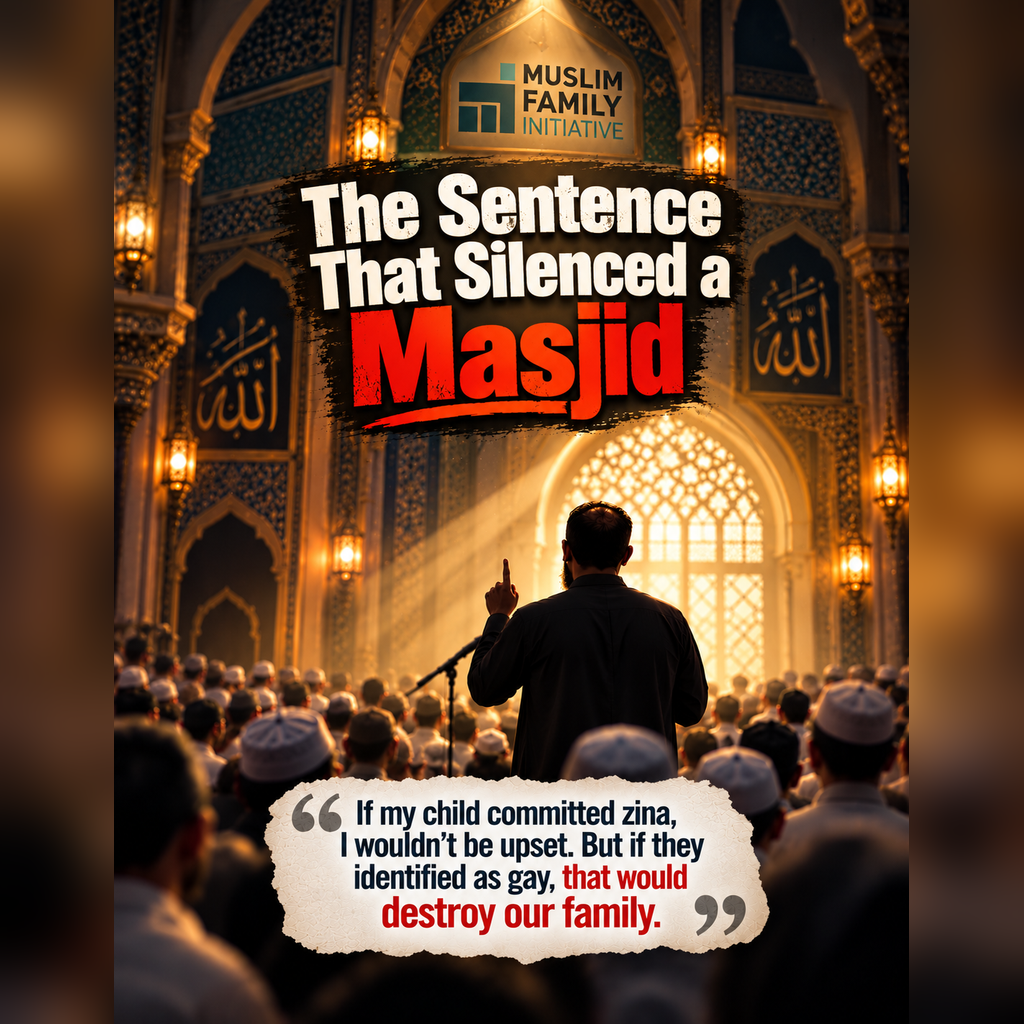
I once finished a talk in a masjid on relationships and sex education in schools. A man stood up and said:
“If my child committed zina, I wouldn’t be upset. But if they identified as gay, that would destroy our family.”
There was stunned silence in the room. I have thought about that sentence many times since, because it was not said out of malice. It was said honestly, and that is what made it revealing. He was telling us how the two things felt to him. He was not telling us how Allah ranks them. If we make our feelings the standard for morality, our morality will fluctuate just as our feelings do.
Who sets the standard
Our love and dislike of behaviours cannot be set by what we feel is good or bad. Allah and His Messenger ﷺ define what is good and bad. They define what we value, what we dislike and what we prioritise. Not our personal tastes, and certainly not our passing opinions.
There is a good reason this matters. Human judgement has limits. It is shaped by bias, by the whims of the age, by whoever shouts loudest and by whoever has the money to influence. Look at how quickly public attitudes to the same behaviour have changed within a single lifetime. If our standard moves with the mood, our children will be standing on shifting ground.
If we want to understand the mindset Allah wants us to develop, there is no clearer case study than the one He gives us in Surah al-Baqarah. Bani Israeel were favoured above the peoples of their time. They were given favour after favour, and each one was a chance to live up to what their Lord expected of them. Yet the Qur’an describes a pattern of response made up of arrogance, pride, contempt, deception and mockery, and above all disobedience. When Musa went away for forty nights to receive revelation for them, they took up the worship of a golden calf. When they were told to slaughter a cow, they kept asking questions in the hope of not having to do it. Again and again they chose selective obedience over complete submission.
Allah says to them: “Do you believe in part of the Book and disbelieve in part?” (Qur’an 2:85). If we want to be among those who receive Allah’s mercy, and not lose it as they did, our values, our priorities, and our sense of what is good and what is harmful must come only from the covenant we made to worship and obey Him.
The Qur’an makes the point about zina in a way that is easy to miss. Allah does not only forbid the act. He says, in the meaning of the verse: “And do not approach zina. Indeed, it is an immorality and an evil way” (Qur’an 17:32). We are told to stay away from the path that leads there. Zina is a major sin, and a parent who shrugs at it has not understood how seriously Allah treats it.
The Qur’an is equally clear about the people of Lut. Their prophet warned them, in the meaning of the verse, that they were approaching men out of desire instead of women, and that they were a transgressing people (Qur’an 7:80 to 81). The Qur’an then describes their destruction (Qur’an 7:84). We accept both rulings for the same reason. We do not accept them because of how they make us feel. We accept them because of who has spoken.
A hierarchy of moral acceptability
Here is what I notice in my own work. I receive many calls from parents desperate for advice about LGBTQ identity issues. I cannot remember a call from a parent worried about zina. Yet we know both are real.
So I have to ask a hard question: have we created a hierarchy of moral acceptability? One sin brings a crisis. Another brings silence.
To be clear, none of this minimises the pain of the families I wrote about in an earlier article. A parent whose child has said “I am gay” is in real distress and deserves compassion and practical help. The point is only that our response should come from the standard Allah has set, and that standard is consistent. A crisis for one and a shrug for the other means our feelings, not our principles, are doing the ranking.
The silence
Silence has a cost, and it is easy to overlook because it is quiet.
I once said on a podcast: your daughter can go to school, a teacher or school nurse can help her arrange an abortion and even be the adult who supports her, and she can come home and you never know about it. People were shocked, but I didn’t see it lead to any action.
In England, a young person under 16 who is judged mature enough to understand the decision can consent to abortion treatment herself, and the clinic can keep that confidential from her parents. The High Court confirmed this approach to confidentiality for under-16s in the Axon case in 2006. The British Pregnancy Advisory Service says under-18s usually need a supportive adult aged 18 or over for travel and aftercare. If a young person cannot tell her parents, it says it can help her find a professional “such as a teacher or school nurse” to support her.
In a case reported in Salford in 2012, teachers discussed an abortion with a 15-year-old, gave her time off school, and her parents learned afterwards. The council said national guidelines had been followed correctly. That is the system working as designed, and it is the part many parents have never been told. The issue is not only abortion. It is the normalisation of zina among some young Muslims, not all of them.
Then there is the story I have not forgotten. About ten years ago, before buffer zones were introduced, a Catholic colleague told me that her organisation was holding vigils outside an abortion clinic in east London. She told me that most of the girls going in were wearing hijabs.
Zina is a common problem among us. It is uncomfortable to say, and that is exactly why it has been normalised through our silence.
What we can do at home
None of this is a call for panic. It is a call to talk, and these are small, practical steps.
1. Name zina plainly and early. Children who have never heard their parents say the word will not bring a problem to them. Explain, in age-appropriate language, that Allah has set limits, that the limits protect us, and that every one of us makes mistakes and can return to Him.
2. Make home the safe place to ask. The man in the masjid was right about one thing. The thought of a child’s sin can feel unbearable. But a child who fears their parent’s reaction will go to someone else. Decide now that your first response to bad news will be to keep the child close, and say so before any crisis.
3. Be consistent. If we treat one sin as a catastrophe and another as a private matter, our children notice. Show them the standard and not just the reaction. We love what Allah loves and we dislike what He dislikes, even when it is hard, and even when it is our own child.
4. Put the attention where it counts. This connects to last week. A child who has twenty minutes of your real attention and one honest question a day is a child who will tell you things. A child who gets silence will find another listener.
A closing thought
Our children copy what we react to. If they see us react loudly to one thing and quietly to another, they learn our feelings and not Allah’s standard. So let us ask Allah to make our hearts love what He loves, and let us break the silence with wisdom and care, starting in our own homes.
Join us
If you want our weekly message for parents on raising strong, Muslim children, join one of our groups:
Join on TelegramJoin on WhatsApp
Got a question or a topic you want us to cover? Reach out at yusuf@muslimfamilyinitiative.org.
Newsletter
© Copyright 2024 – Muslim Family Initiative