
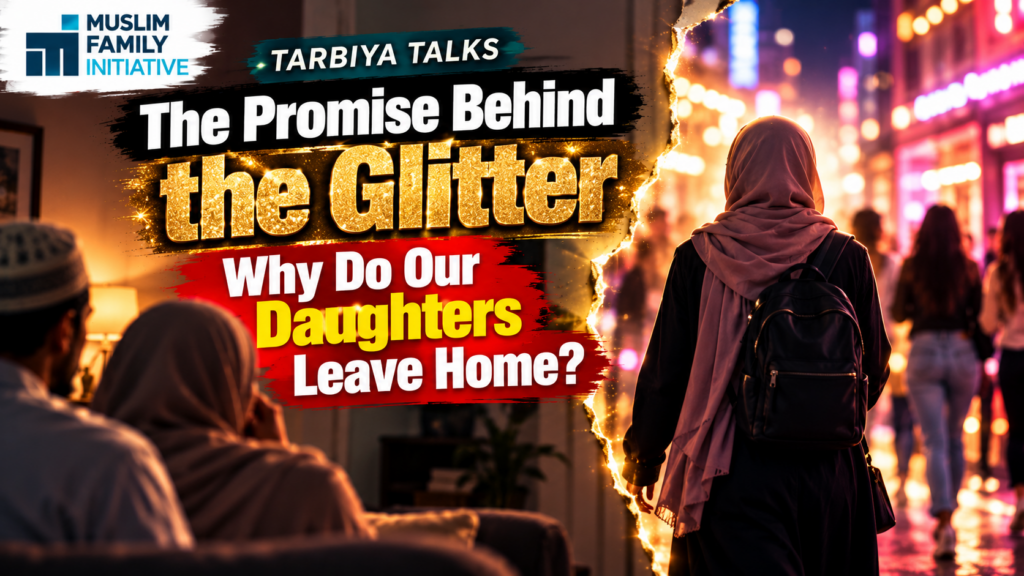
Why Do Our Daughters Leave Home?
All names in this article are pseudonyms.
Jameelah
I speak to many parents whose daughters leave home. It is most often daughters. The parents who tell me are rarely angry. They are bewildered, and they keep asking the same question: how did we get here?
Let me tell you about a young woman I will call Jameelah. She came to identify as a lesbian, and she believed her parents and her wider family stood in the way of who she had been told she was. So she left home.
The promise behind the glitter
To Jameelah, family meant work and effort. It meant obligations, expectations, and people who needed things from her. It asked for her time, and it asked her to think about someone other than herself.
The world outside offered the opposite. Secular-liberal society puts the individual at the centre of everything, and tells us to immerse ourselves in what pleases us and fulfils our desires. Society has not given up worship. It has replaced God with the self.
On the face of it, that sounds appealing. But when we look more deeply, there is a rotten core hidden under a veneer of glitter. A life with no limits also has nobody who is responsible for you, and nobody you are responsible for.
And she chose it without questioning the worldview underneath it.
How family is framed
Look at how society frames the family. Negative. Toxic. Constricting. Restricting.
Every mother is overbearing and every father is controlling. Religion controls you. Families restrict you. No one should tell you what to do. We hear it in phrases that sound kind: “Don’t let shame imprison you.” “Live life to the fullest.”
That language sounds neutral, but language is never neutral. It comes from a worldview, and it advances that worldview, while expecting us all to accept its claims. Once we accept the words, we have often accepted the conclusion they were built to reach.
Some people have been hurt by their own families, and that pain is real. It deserves to be heard and taken seriously. But when the hurt becomes the default story about every family, a young person learns to see her parents as obstacles to be escaped, rather than as the people who carried her.
Rights and responsibilities
Underneath that story is a culture built on rights.
Rights matter. Islam gives rights to parents, to children, to spouses and to neighbours. This is not a case against rights.
But for a believer, the main concern is responsibility. My responsibility is how I fulfil someone else’s right. And that is closely tied to something far bigger: accountability before my Creator, which matters more than anything else.
When a culture is built on rights, the emphasis shifts. We spend our energy fighting for what we are owed, and forget to ask what we owe. A person who only asks what she is owed will always find her family falling short. A person who asks what she owes will see her family very differently.
Three questions
So I ask three questions.
- Was she created to satisfy her desires without restriction, or is there a higher purpose?
- Whatever the answer, where does this worldview come from?
- What basis does it have to truth?
Allah tells us, in the meaning of the verse, that He did not create the jinn and mankind except to worship Him (Surah adh-Dhariyat, 51:56). That is a purpose that gives family its meaning, and gives limits their reason.
The values our children meet every day
You can’t give what you don’t have. If we want our children to hold on to purpose, we have to strive to live by it ourselves. Then we can use the everyday examples of contrary values our children are surrounded by, to remind them what we stand for and why. Here are four.
1. Individualism puts “me” first.
Our tradition teaches the opposite: preferring the rights of others over our own. The Prophet ﷺ promised a home in Jannah for the one who leaves an argument even when he is in the right. That takes setting aside ego, which individualism elevates until proving we are right matters more than anything else.
In the moment, you might say: “Notice how hard it is to walk away when you know you’re right. Allah gave that a reward.”
2. Secularism makes people the gods.
It allows God a place in private life, but in public life people decide what is right and wrong.
In the moment, you might say: “Who decided that? And what are they basing it on?”
3. New is assumed to be better than old.
We often hear that the Deen of Allah needs reform to match what people have decided is good in the last ten years, and the legislation of Allah is dismissed as archaic. I once followed an online conversation in which a Muslim made a straightforward, mainstream Islamic point: the man is responsible for the financial maintenance of his family. Someone replied, with no explanation, “that’s archaic.” That response overlooks something basic. Our Creator knows us best, so He knows what is best for us, and this is reflected in His legislation.
In the moment, you might say: “Is something wrong because it’s old? What would make it wrong?”
4. Roles are confused, and the confusion is exploited.
Many men and women are unsure what their roles are. Fringe voices at either end react to that confusion as antagonistic enemies, which poisons the pool further. There is no firm criterion for how human relationships should work, and that follows directly from removing our Creator’s guidance from everyday life.
In the moment, you might say: “Who is meant to decide how men and women treat each other? What happens when nobody agrees?”
The goalposts keep moving. Society keeps changing what counts as moral or immoral, and the basis for each change is as confused as the last. When God is removed from these decisions, human beings make them, with little care for the wider consequences.
What way are we leading to?
Connecting our children to purpose starts with us. We strive to live by it ourselves, and then we remind them, through the everyday examples they see, what we stand for and why.
You can’t give what you don’t have.
We set the standards. We set the priorities. We lead, and our children follow.
So the question is: what way are we leading to?
May Allah guide us, and our children, to their purpose.
Join us
Get our weekly message for parents on raising strong, Muslim children.
Join us on TelegramJoin us on WhatsApp
Questions or topic suggestions? Email yusuf@muslimfamilyinitiative.org
Newsletter
© Copyright 2024 – Muslim Family Initiative