
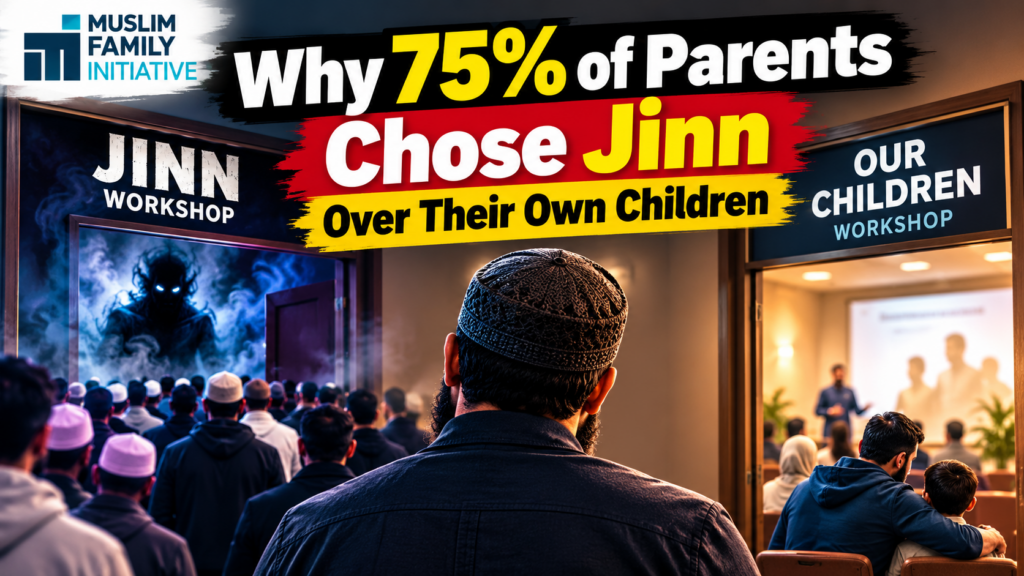
which workshop would you choose? what our attention says about our priorities
At a large family conference I attended a few years ago, mothers and fathers were asked to choose between two workshops running at the same time. One was on jinn. The other was mine. It covered what children are taught in schools about sexual relationships and LGBTQ, and how parents can respond proactively at home.
Guess which one about three quarters of the room chose.
It wasn’t mine!
I want to be clear that this is not a criticism of the other workshop or of the people who attended it. Curiosity about the unseen is natural, and there is real value in understanding what Allah has told us about it. But the choice that room made tells us something important, and it is worth pondering over it.
Attention is priority
We often say that our children are our top priority. Our attention tells a different story.
What we give our time, energy and curiosity to is what we actually prioritise, whatever we say with our mouths.
And in our age attention is drawn to what is dramatic and exciting. A talk on the unseen has mystery and intrigue, it doesn’t ask anything of you.
Whilst a workshop on school curricula, online influences and the slow shaping of a child’s beliefs has none of that. It is practical and uncomfortable, and it asks something of us.
Where the real exposure is
Consider the question honestly. Far fewer families will ever be directly affected by jinn. Almost every family will be affected by the influences that shape our children. What they are taught at school. What they see on their phones. Who they spend time with. What they gradually come to believe about identity, relationships, and right and wrong.
These influences do not arrive with a warning. They work slowly, through ordinary days, and by the time a parent notices, a child’s thinking may already have shifted. In my work with families, the phone calls I receive are rarely about the dramatic and the unseen.
They are about a child who has drifted, a teenager who has stopped talking, or a young person who has walked away from what they were raised with.
Why raising children gets so little attention
If this matters so much, why does it attract so little of our energy?
Raising children is unexciting. There is no drama in a daily conversation, a shared meal, or a difficult talk at bedtime.
There is no immediate reward and no visible moment where we can say, “That’s the day I protected my child.” The work is slow, repetitive and quiet. And let’s face it, raising children is a thankless task.
It also asks us to change ourselves. Learning what our children are being taught means leaving our comfort zone. Building a relationship they actually want to be part of means giving up time and distraction. It is far easier to attend a talk about something distant than to do the daily work of being present in our own home.
Yet it is exactly this quiet work that decides how our children turn out.
The accountability we carry
The Prophet ﷺ said: “Each of you is a shepherd, and each of you is responsible for his flock.” [Agreed Upon] A father is a shepherd over his household, and a mother is a shepherd over her home and her children.
And Allah says in the Qur’an: “O you who believe, protect yourselves and your families from a Fire whose fuel is people and stones” (66:6).
This is not a suggestion to give our children some attention when we have spare time. It is a responsibility we will be asked about in front of our Lord. Protecting our families is not only about their physical safety and their education. It includes what shapes their hearts and minds.
Moving from awareness to action
None of this requires dramatic change. A few small, consistent steps are far more powerful than a single burst of effort.
1. Audit your attention. For one week, notice honestly where your time and energy go. How much goes to your children’s inner world, and how much to everything else?
2. Learn what they are being taught. Find out what your children’s school teaches about Relationships and Sex Education, and when. You cannot respond to what you do not know. Our toolkit on challenging inappropriate teaching in schools is free on our website.
3. Build the relationship first. Children listen to the people they feel loved by. Spend one-to-one time with each child, ask real questions, and listen to the answers without rushing to correct. Our toolkit on fathers, children and love is available to download and our workshop recording is on our fathers resource page.
4. Anchor them in certainty. Help your children build a real, personal relationship with Allah, and make sure they hear from you, in your own words, why we believe what we believe. Download our toolkit on Purpose.
5. Put the phone away for twenty minutes. It sounds small, and it is. But a child who gets twenty minutes of your full attention each day understands where they stand in your life.
Join us
If you want our weekly message for parents on raising strong, Muslim children, join one of our groups:
Join on TelegramJoin on WhatsApp
Got a question or a topic you want us to cover? Reach out at yusuf@muslimfamilyinitiative.org.
Newsletter
© Copyright 2024 – Muslim Family Initiative